
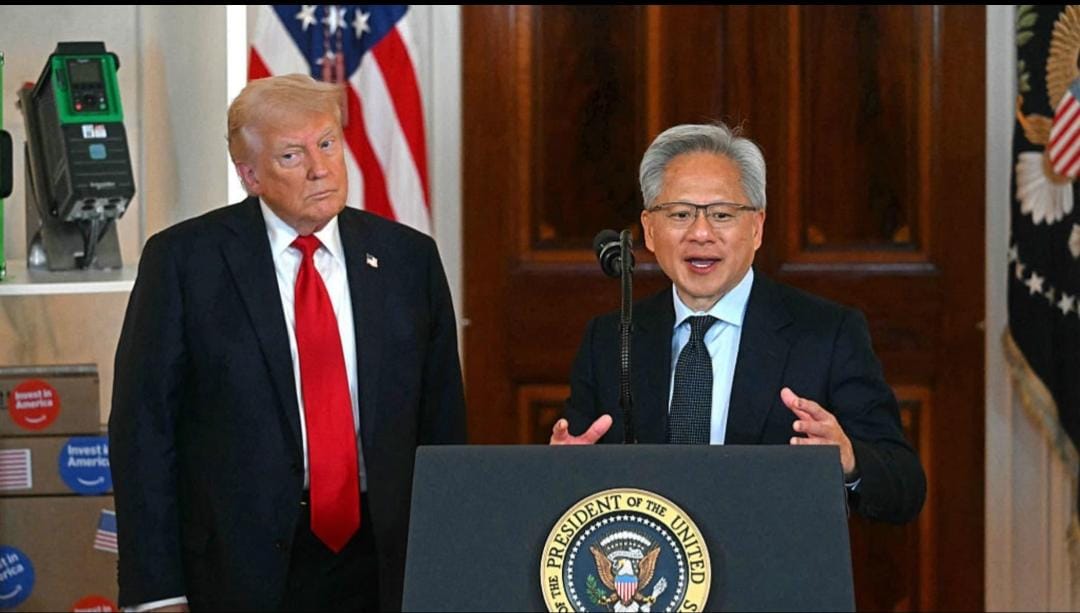
Source: "Reuters — US plans to name Nvidia and other AI firms as “national champions”" (https://reference-url-citation.invalid/1)
The global race for Artificial Intelligence is entering a new phase, with the United States reportedly preparing an initiative to designate more than two dozen AI companies as “national champions.”
According to a Reuters report published on November 16, 2026, the Trump administration plans to identify leading American AI companies to help them expand internationally and compete more effectively with Chinese technology companies.
The companies reportedly included in the proposed group are Nvidia, OpenAI, Microsoft, Amazon and Anthropic.
The development highlights how Artificial Intelligence has evolved beyond being simply a technology-sector trend. AI is increasingly becoming a strategic economic, industrial and technological priority for major economies.
Why Do AI “National Champions” Matter?
The proposed programme reflects growing competition between major technology economies, particularly the United States and China.
Developing advanced AI technologies requires enormous investments in computing infrastructure, specialised semiconductors, data centres, research and engineering talent.
Different companies play important roles across this ecosystem.
- Nvidia: Develops advanced GPUs and computing technologies that power modern AI systems.
- OpenAI: Develops generative AI models and AI-powered applications.
- Microsoft: Provides cloud infrastructure, enterprise AI platforms and AI development tools.
- Amazon: Operates major cloud computing infrastructure through Amazon Web Services (AWS).
- Anthropic: Develops advanced AI models and enterprise-focused AI solutions.
Supporting these companies in international markets could have implications beyond individual businesses.
It could influence the global technology market across AI infrastructure, cloud computing, semiconductors, generative AI and enterprise AI applications.
AI Competition Is Becoming a Global Technology Race
The competition between countries is no longer limited to developing the most advanced AI model.
Nations are increasingly competing across the entire Artificial Intelligence technology ecosystem.
Some of the most important areas include:
- AI Chips and Semiconductors: Developing powerful processors required to train and operate advanced AI models.
- Data Centres: Building large-scale infrastructure to support AI computing requirements.
- Large Language Models (LLMs): Developing advanced AI systems capable of understanding and generating human language.
- Cloud Computing: Providing scalable computing resources for businesses and developers.
- AI Agents: Creating intelligent systems capable of performing tasks and automating workflows.
- Generative AI: Developing technologies that generate text, images, videos, audio and other content.
- Robotics: Integrating AI into machines and autonomous systems.
- AI Research: Advancing the scientific and engineering capabilities behind artificial intelligence.
- Enterprise AI: Building AI solutions for business operations, productivity and decision-making.
This growing competition makes Artificial Intelligence an increasingly important component of national economic and technology strategies.
Nvidia's Role in the Global AI Ecosystem
Nvidia occupies an important position in the modern AI industry because advanced AI models require significant computing power during both training and deployment.
Its Graphics Processing Units (GPUs) are widely used in AI data centres and high-performance computing environments.
Training large AI models involves processing enormous amounts of data and performing complex mathematical calculations. High-performance GPUs help accelerate these operations.
As demand for AI continues to expand, access to computing capacity is becoming an important competitive advantage for technology companies and countries.
This also highlights the close relationship between AI software and hardware.
A powerful AI model depends not only on its algorithms but also on the infrastructure available to train, operate and scale it.
How Could the US Initiative Affect the Global AI Industry?
If implemented, the proposed programme could strengthen the international expansion of major American AI companies.
It could also help promote the adoption of US-developed AI technologies in international markets.
The potential implications include:
- Increased international competition in AI infrastructure.
- Greater demand for advanced AI chips and computing systems.
- Expansion of American cloud computing and AI platforms.
- Increased investment in generative AI research and development.
- Greater competition between American and Chinese AI technology providers.
- New opportunities for businesses adopting enterprise AI solutions.
However, the specific benefits and implementation details of the proposed designations have not yet been fully established in the Reuters report.
What Does This Mean for AI Developers and Technology Professionals?
The growing global investment in Artificial Intelligence could create opportunities across multiple technology fields.
As companies compete to develop and deploy advanced AI systems, demand for professionals with specialised technical knowledge may continue to grow.
Some important skill areas include:
- Artificial Intelligence (AI)
- Machine Learning (ML)
- Generative AI
- Large Language Models (LLMs)
- AI Engineering
- Cloud Computing
- Data Science and Data Analytics
- Prompt Engineering
- Agentic AI Development
- AI Automation
- MLOps and AI Deployment
Developers who understand how to build, integrate and deploy AI applications will be able to explore opportunities across startups, technology companies and enterprise organisations.
The future AI workforce will require more than the ability to use AI tools. Understanding how AI models work, how they are trained and how they can be integrated into real-world applications will become increasingly valuable.
The Bigger Picture: AI Is Becoming a Strategic Global Industry
The proposed US “national champions” initiative highlights how quickly Artificial Intelligence has evolved from an emerging technology into a strategic global industry.
The future competition will not simply be about who develops the most advanced chatbot.
It will involve several interconnected technologies, including AI models, semiconductors, computing infrastructure, data, cloud platforms, research capabilities and real-world applications.
For the United States, supporting leading AI companies internationally could become part of its broader strategy to strengthen its position in the global technology market.
For other countries, including India, these developments highlight the importance of building domestic AI capabilities, investing in research and infrastructure, and developing skilled AI professionals.
The next phase of the global AI race will not be defined only by who builds the smartest AI model, but also by who can develop, support and deploy AI technology at a global scale.